
AI Governance in Peru: Digital Talent as Algorithmic Governance and What Peru’s National Strategy Reveals About Who Systems Are Designed to See

Updated: Apr 21

Every digital talent strategy in Latin America contains a decision its authors prefer not to make explicit: who will remain invisible to the automated systems that will later evaluate them. This is not only a workforce issue, but a digital talent AI governance Peru problem with direct implications for how algorithmic systems include or exclude populations.
Every digital talent strategy in Latin America contains a decision its authors prefer not to make explicit: who will remain invisible to the automated systems that will later evaluate them. The populations a strategy fails to train do not simply miss an opportunity. They become, with considerable reliability, the populations that algorithmic systems misread, exclude, and cannot evaluate.
The two problems are not parallel. One produces the other. Peru’s National Digital Talent Strategy, co-designed by an expert committee convened by the Secretariat of Government and Digital Transformation in 2021, was one of the first policy processes in the region to take that connection seriously. What the committee found was specific, uncomfortable, and directly relevant to every institution in the region now deploying automated decision systems.
A digital talent strategy that cannot reach the informal worker is not a universal strategy. It is a program for the formal minority, wearing a mission statement that claims the informal majority.
Who the system is really for
Every national digital talent strategy begins with a question its authors prefer not to examine too carefully: who is this for. Not in the aspirational sense. In the operational sense: who gets trained, in what, at what depth, with what connection to actual employment, and with what guarantee that the skills acquired today will remain useful when the technology has moved on. These questions do not resolve themselves through goodwill. They require deliberate choices. And deliberate choices require someone willing to make them explicit rather than leaving them embedded in the default settings of whoever wrote the curriculum.
Peru had a digital skills gap. It also had the standard institutional response to digital skills gaps: a national strategy. These are not the same thing, though the confusion between them is very common and almost always expensive.
The Expert Committee convened by the Secretariat of Government and Digital Transformation of the Presidency of the Council of Ministers in September 2021 was tasked with designing that strategy. Its members came from the Ministry of Education, the Ministry of Women, San Agustín National University, the International Society for Technology in Education, Cisco, Women in Tech Peru, and civil society organizations whose constituencies included the populations that national digital talent strategies most frequently describe as beneficiaries and most consistently fail to reach. The legal architecture came from Decreto Supremo N° 029-2021-PCM, which mandated a National Digital Talent and Innovation Strategy, and from Decreto de Urgencia N° 006-2020, which created the National Digital Transformation System. Understanding those instruments was the prerequisite for producing anything that would survive contact with the institutional reality they were intended to reshape.
The visibility gap
The diagnosis was direct. Peru’s digital skills gap is real. But its most consequential dimension is not the gap between what people know and what technology requires. It is the gap between what the formal training infrastructure can see and what the population actually needs. The International Labour Organization’s 2025 Labor Panorama places informal employment at 46.7 percent of the working population across Latin America and the Caribbean. In Peru, according to the same source, informality approaches 70 percent. A digital upskilling program that assumes a stable employment relationship, a functional device, reliable connectivity, and the ability to complete sequential training modules during regular working hours is not a universal program. It is a program for the formal minority, wearing a mission statement that claims the informal majority.
The visibility gap is not between what people know and what technology requires. It is between what the formal training infrastructure can see and what the population actually needs.
Designing for the formal minority
Peru’s digital economy is also, in large part, an economy built by women. Peru has a large and growing base of women-led micro-businesses, most of which have never interacted with a formal training system and will not begin doing so because a strategy appeared in the Diario Oficial El Peruano. The Economic Commission for Latin America and the Caribbean’s Social Panorama 2024 documents that the labor force participation gap between men and women in the region exceeds twenty percentage points, driven by the concentration of unpaid care work on women.
A training schedule that assumes full-time availability will systematically disadvantage women with caregiving responsibilities. A curriculum that uses male-dominated professional contexts as its default examples sends consistent signals about who the digital economy is designed for. An assessment framework that measures technical output without accounting for access barriers produces results that look like differential aptitude. They are differential opportunity. The distinction matters, because one of them can be fixed and the other cannot.
These were not hypothetical risks. They were the documented baseline from which the committee was working.
Three principles the committee refused to leave implicit
Three principles structured the roadmap that followed. Each required naming an assumption that the standard policy process leaves unexamined.
The first was modular flexibility: training pathways completable in fragments, across interrupted schedules, on multiple devices, without requiring continuous enrollment to accumulate recognized credentials. Educational institutions whose accreditation frameworks had been built around the opposite assumption required substantial persuasion. The opposite assumption being, roughly, that students have the luxury of attending. Modular design is not a technical preference. It is a political position: it asserts that the training system should adapt to the realities of learners’ lives rather than requiring learners to adapt to the rhythms of institutional delivery.
The second was sectoral anchoring: skills tied to employment opportunities actually available in Peru’s economy, rather than to the generic technical competencies that global frameworks tend to favor because they transfer elegantly to global reports. Cloud computing certifications have limited value in an economy where the primary digital employment growth is occurring in e-commerce, digital financial services, and technology-enabled agriculture. A strategy that trains for competencies the local labor market does not yet absorb is not a strategy for inclusion. It is a strategy for credentialing.
The third was institutional accountability: biennial review cycles requiring institutions to produce evidence of outcomes rather than outputs, and triggering strategy revisions when the evidence showed that the populations the strategy was designed to reach were not being reached. A strategy that measures total training hours without disaggregating by gender, employment formality, geographic distribution, and connection to actual employment can succeed on its own metrics while failing everyone it was nominally designed to serve. The biennial review was not procedural caution. It was the only mechanism available to create the institutional pressure required to close the gap between what the strategy claimed to do and what it actually did.
Decreto Supremo N° 157-2021-PCM created the Plataforma Nacional de Talento Digital, the delivery infrastructure for the strategy, providing free access to competency content across cybersecurity, digital identity, internet governance, and emerging technologies. The platform exists. The question the committee had spent months attempting to answer was whether the population that most needed it could use it, and whether the credentials it offered would connect to employment or to a document that looked impressive in a government report and changed nothing in a labor market that had not agreed to value it.
The platform exists. The question is whether the population that most needs it can use it, and whether the credentials it offers connect to employment or only to a document that looks impressive in a government report.
The governance consequence
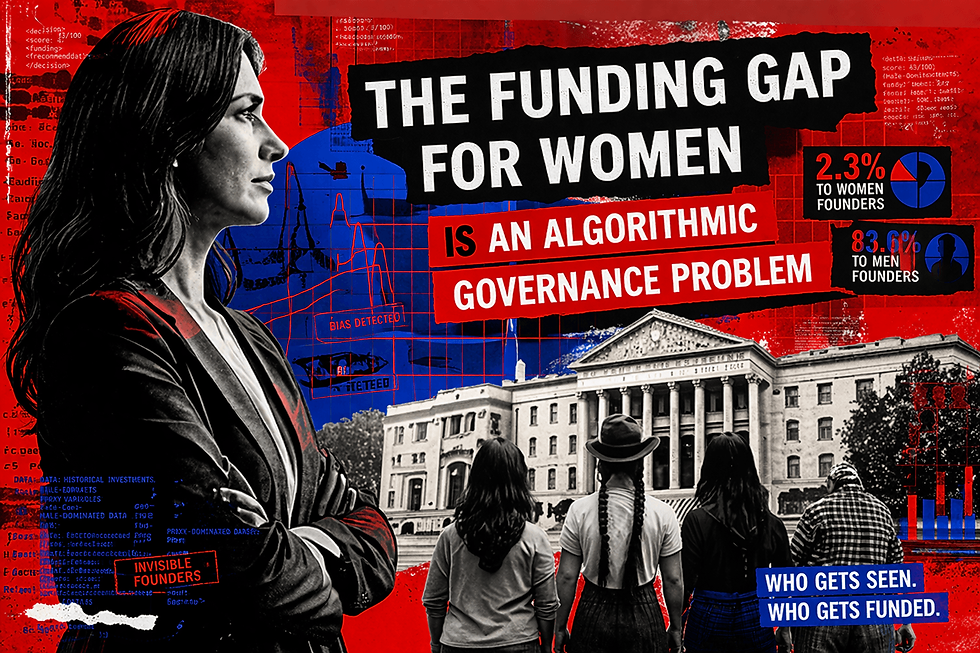
What does any of this have to do with AI governance? Everything. The connection runs in both directions and is worth stating plainly. The populations a national digital talent strategy fails to train become the populations automated decision systems are most likely to misread. The worker without a formal digital credential, the woman whose employment history reflects caregiving rather than disengagement, the young person whose skills developed outside the formal infrastructure: these are the people whose profiles are least legible to algorithmic systems calibrated on formally documented competencies. Exclusion from digital talent development compounds exclusion from the economic opportunities those systems now control.
The Latin American Artificial Intelligence Index, ILIA 2025, documents that Latin America accounts for 14 percent of global visits to AI solutions while investing only 1.12 percent of global AI investment, against 6.6 percent of global GDP. The region is a large and enthusiastic consumer of systems it had almost no role in designing, built for conditions that differ from its own, and evaluated using metrics not developed with its populations in mind. That asymmetry does not correct itself. It requires institutions willing to invest in the capacity to evaluate, contest, and where necessary modify the systems being consumed, and a workforce with the critical literacy to recognize when modification is warranted.
Training workers to use digital tools without training them to understand the governance implications of those tools produces a specific and underappreciated risk. It creates a population of capable users who cannot recognize when the systems they are operating produce results that should be questioned, or how to communicate that to someone with the authority to act on it. Knowing how to use an AI tool and knowing when its output is wrong in a way that matters are not the same competency. The second is considerably rarer and considerably more consequential.
What the law now says and what it does not resolve
Peru approved Ley N° 31814 in 2023, establishing the first comprehensive AI governance framework in the region, with a risk-based structure designating high-risk sectors including biometric identification, educational admissions, and employment decisions. These are precisely the sectors where the digital talent gap creates the greatest exposure to algorithmic exclusion. The Política Nacional de Transformación Digital al 2030, approved by Decreto Supremo N° 085-2023-PCM, establishes the strengthening of digital talent alongside the governance of emerging technologies as linked strategic objectives. The connection is now explicit in the law in a way it was not explicit when the committee was working in 2021.
What the policy framework has not resolved is the operational question the committee was wrestling with from the beginning: how to build digital capability in a population that is predominantly informal, predominantly constrained by caregiving, and predominantly excluded from the formal training infrastructure that the policy framework assumes as its delivery mechanism. Having the right legal architecture and having the institutional capacity to make that architecture work on the ground are not the same condition. Peru has made more progress on the first than any other country in the region. The second remains the harder problem.
The policy illusion and what replaces it
National digital talent strategies are not scarce. Most countries in the region have one. What is scarce is accountability for what those strategies actually produce, because genuine accountability requires treating the distance between what a strategy claims and what it delivers as a governance failure rather than an acceptable rounding error in a document that needed to be published.
Every board member at an institution deploying AI-assisted hiring, credit scoring, or service eligibility decisions should ask one question about their organization’s AI governance framework: does it include a provision for the workers and applicants whose profiles were formed outside the formal systems the models were trained on? If the answer is no, the governance framework is not governing the actual population. It is governing the population the system was built to see, which is a different and considerably smaller group.
Every regulator drafting AI governance requirements should ask the parallel question about the digital talent strategy their country has adopted: does it reach the informal worker, the woman balancing caregiving and employment, the young person in a region with limited connectivity? If the answer is no, the strategy is not building the workforce that AI governance will require. It is building a credentialed subset of that workforce, and leaving the rest to be misread by systems that were never designed to evaluate them.
What this produces
A digital talent strategy that reaches the informal worker, the woman balancing caregiving and employment, the young person in a region with limited connectivity, is not simply more equitable. It is more accurate: producing a workforce that reflects the economy it is intended to serve, generating the data that AI systems need to make defensible decisions, and building the critical literacy that makes it possible for people to recognize and contest the automated outputs that increasingly govern their access to employment, credit, education, and public services.
That is the work the Expert Committee was convened to begin. It is also, in every country in the region, the work that remains most urgently incomplete. Not for want of strategies. For want of the institutional honesty required to measure what those strategies actually produce, and to treat that number as information worth acting on rather than a figure best omitted from the executive summary.
Every digital talent strategy already determines who AI systems will misread. The question is not whether a country has a strategy. It is who that strategy is leaving invisible.
References
Presidencia del Consejo de Ministros del Perú. PCM inicia diseño de la Estrategia Nacional de Talento Digital. Diario Oficial El Peruano. Lima, 2021. https://elperuano.pe/noticia/128237-pcm-inicia-diseno-de-la-estrategia-nacional-de-talento-digital
Decreto Supremo N° 029-2021-PCM. Reglamento del Decreto Legislativo N° 1412, Ley de Gobierno Digital. Lima: Presidencia del Consejo de Ministros, 2021.
Decreto de Urgencia N° 006-2020. Crea el Sistema Nacional de Transformación Digital. Lima: Presidencia del Consejo de Ministros, 2020.
Decreto Supremo N° 157-2021-PCM. Crea la Plataforma Nacional de Talento Digital. Lima: Presidencia del Consejo de Ministros, 2021.
Decreto Supremo N° 085-2023-PCM. Política Nacional de Transformación Digital al 2030. Lima: Presidencia del Consejo de Ministros, 2023.
Ley N° 31814. Ley que establece un marco de gobernanza para la inteligencia artificial en el Perú. Lima: Congreso de la República del Perú, 2023.
International Labour Organization. Panorama Laboral 2025: América Latina y el Caribe. Geneva: ILO, December 2025.
CEPAL. Panorama Social de América Latina y el Caribe 2024. Santiago: CEPAL, 2024.
CEPAL and Centro Nacional de Inteligencia Artificial de Chile. Latin American Artificial Intelligence Index, ILIA 2025. Santiago: CEPAL, October 2025.
IDB Lab, Endeavor Mexico, and Value for Women. wX Insights 2024: The Rise of Women STEMpreneurs in Latin America and the Caribbean: Reducing the Gap in Access to Capital. Washington, DC: IDB Lab, July 2024. https://doi.org/10.18235/0013077
Journal of Innovation and Entrepreneurship. Profile of Female Entrepreneurship in Pre-Pandemic Latin America: Trends and Challenges. Berlin: Springer Nature, December 2025.
About the author
Isabel Velarde is Executive Fellow in AI Governance and Responsible AI at the Digital Growth Collective, London, and President of the Gender Equality in Technology Committee at the World Business Angels Investment Forum, affiliated with the G20 Global Partnership for Financial Inclusion. She served as a member of Peru's National Digital Talent Strategy Expert Committee, convened by the Secretariat of Government and Digital Transformation of the Presidency of the Council of Ministers. She writes on AI governance, algorithmic accountability, and digital policy in Latin America.


Comments